The Portfolio That Says Too Much
A focused creative portfolio helps people understand your work faster. See how a small, coherent selection can make your strengths and process clear.
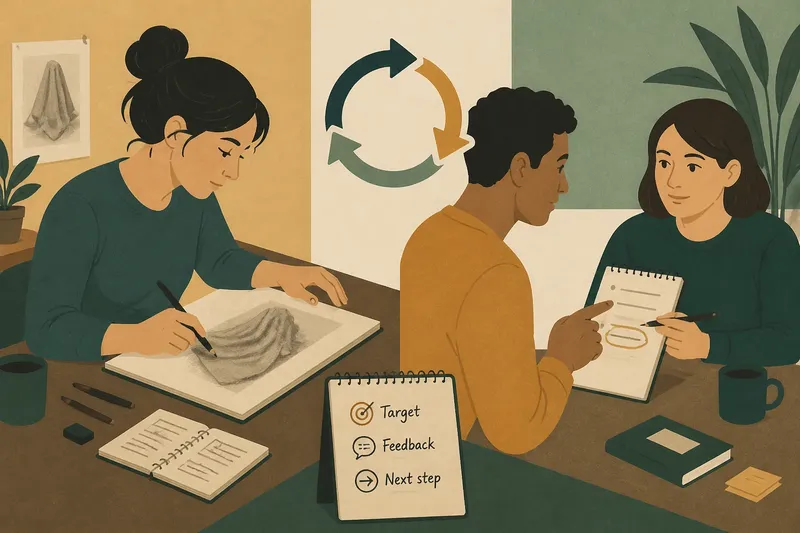
A focused creative portfolio makes it easier for a viewer to see what kind of work you want to do and how you approach it. A crowded collection can bury the strongest evidence beneath projects that point in unrelated directions.
A crowded portfolio obscures the work’s point
Imagine a designer named Maya applying for a role creating visual identities for neighborhood food businesses. Her portfolio contains packaging, event posters, a mobile app concept, personal illustrations, presentation slides, and an early logo exercise. Each piece has a story, and she worries that removing any of them will make her experience look thinner.
But a hiring manager opening the portfolio has a practical question: can Maya make a visual identity that works across the places a small business meets its customers? The collection does not answer quickly. Strong projects sit beside experiments for unrelated audiences, and the viewer must infer which work reflects Maya’s current abilities.
Too much variety can create a second problem. If the work appears to point in several directions, a viewer may not know what kind of assignment to discuss with you. A portfolio is not a complete archive of everything you have made. It is an edited introduction to the work you want to be considered for.
Start by naming the opportunity the portfolio needs to support. That might be a particular kind of job, client, collaboration, or creative commission. A clear purpose makes selection less personal: a piece can be worthwhile and still be wrong for this particular collection.
Portfolio editing starts with the intended opportunity
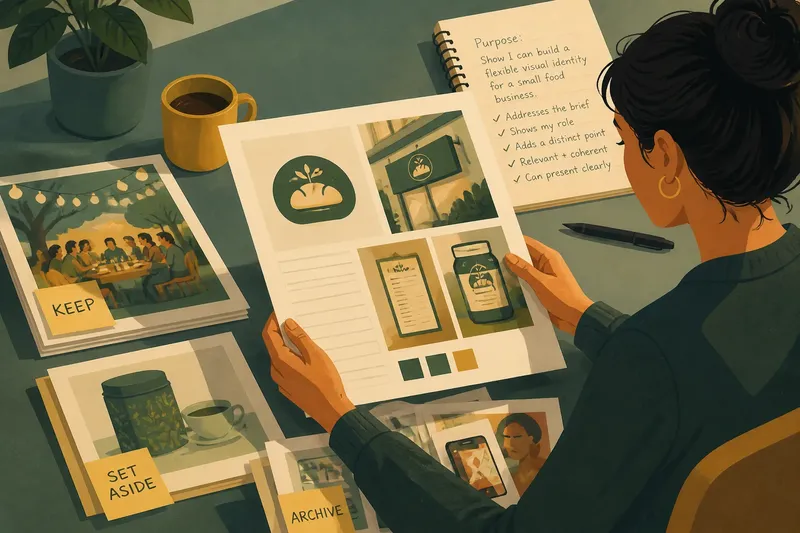
Maya begins with a plain sentence: “I want to show that I can build a flexible visual identity for a small food business.” She does not claim that this is the only work she can do. It gives her a useful filter for deciding what a stranger needs to see in this portfolio.
She reviews each project and asks:
- If a project addresses a problem related to the opportunity, keep it in consideration; if not, set it aside for another audience or your archive.
- If it shows a skill you want a viewer to recognize, consider keeping it; if it does not, remove it unless it supplies necessary context.
- If you can explain your contribution clearly, keep assessing the project; if your role is unclear, add an accurate credit or leave the work out.
- If it adds a distinct point, keep it; if it repeats a stronger project, choose the clearer or more relevant one.
- If you can present the work with the context and permissions it needs, include it if it serves the portfolio; if not, describe it in permitted general terms or omit it.
- If the project supports your current direction, retain it for comparison; if it distracts from that direction, move it to your private archive.
These questions are not a scoring system. They help separate a project’s personal importance from its usefulness to the person reading. Maya keeps a copy of her full archive elsewhere, so editing the portfolio does not mean erasing her past work or denying that it taught her something.
Say Maya has a playful poster for a community supper, packaging for a fictional tea brand, and a real identity project for a local bakery. The invented situation starts with all three pieces mixed among unrelated experiments. She keeps the bakery identity because it directly addresses her target work, retains the supper poster because it shows a distinct way she handles food-related communication, and sets aside the tea packaging because it repeats much of the bakery project’s visual territory. The expected observable result is a collection in which a viewer can identify the intended kind of work without sorting through several similar demonstrations.
A coherent selection shows range without scattering attention
Coherence does not require every project to look alike. It means the projects help explain a shared kind of contribution. A portfolio can show different visual styles, audiences, or formats while remaining legible if the connection is clear: perhaps each project turns a business’s character into practical materials, or each combines research and illustration for public-facing communication.
Maya chooses a small group of projects that show different parts of the same capability. The bakery identity shows how she developed a visual system. A menu and label demonstrate how the system adapts to useful formats. The supper poster offers a different visual tone while staying close to the food and community setting she wants to work in.
She does not include an app concept simply because it is polished. It was made for a different kind of problem, and it takes space away from work that answers the hiring manager’s question more directly. If a conversation later turns to digital product design, Maya can share it then. The portfolio does not need to anticipate every possible conversation at once.
For each selected project, Maya writes a short explanation that covers the brief, her role, the decisions she made, and what the finished work needed to do. She avoids presenting group work as a solo achievement. If a printer, photographer, client, or collaborator shaped the result, she names that contribution where it helps the viewer understand the work.
A coherent portfolio is not a set of repeated proofs. Each project should earn its place by adding a useful dimension: process, format, audience, collaboration, or a different way of solving a related problem.
Project context helps viewers read the work fairly
A polished image by itself can leave important questions unanswered. Was the work a personal exercise or a commissioned assignment? Which parts did the creator make? What constraint shaped the choices? A short, direct caption can answer these questions without turning every project into a long case study.
Maya’s bakery page opens with the client’s need for a recognizable identity that could appear on a sign, a menu, and product labels. She states that she led the visual design and worked with the owner on the business’s tone. Then she shows the identity across a few relevant applications, rather than filling the page with every mockup she made.
She also includes one decision that reveals her thinking. The owner wanted the business to feel welcoming rather than formal, so Maya used a hand-drawn mark and a restrained palette. This does not need to be described as a universal design rule. It shows how a specific choice responded to a specific brief.
When the finished work cannot be shown, Maya can describe the project in general terms or use material she has permission to share. Confidentiality and usage rights matter; the relevant agreement, client terms, or professional advice should guide what can be displayed. A portfolio should make a viewer confident in both the work and the judgment behind presenting it.
What should a project page explain?
How many projects should a portfolio include?
Include enough work to show the relevant range, but not so much that a viewer must decide which projects matter. The right selection depends on the opportunity and the strength of the available material, not on a universal target.
Should older work stay in the portfolio?
Keep older work when it remains relevant and shows something valuable that the newer projects do not. Remove it when it distracts from your current direction or duplicates a stronger example.
Can a portfolio show different styles?
Yes, if the selection still makes your intended contribution understandable. Give each project enough context to show why its style suited its audience or purpose.
What if a project was collaborative?
State your role plainly and identify collaborators when their contributions shaped the result. Clear credit helps viewers judge your skills without mistaking shared work for individual work.
The final edit should make the next conversation easier
After selecting and explaining her projects, Maya asks a colleague who does not know the work to browse the portfolio. She asks what kind of assignments the pages suggest and which project prompted the clearest question. The point is not to seek approval of every design choice. It is to notice whether the collection communicates the direction she intended.
The colleague sees the food-business focus and asks how the bakery identity would adapt to a seasonal promotion. That question gives Maya a useful opening to discuss the system and its limits. Before editing, the same colleague had asked what the portfolio was supposed to represent. The change is not a promise of a job; it is a more focused conversation about the work.
Maya keeps the omitted pieces in an archive and reviews the public selection when her goals change or new work adds a genuinely different strength. She does not restore projects merely to make the collection look fuller. Each addition needs a reason the current selection cannot already supply.
A portfolio that says less can still show substantial skill. The useful test is whether every project helps a viewer understand the work you want to do, the part you can contribute, and the question worth asking next. For a portfolio that says too much, remove the pieces that make those answers harder to see.