Plan a First Team Project Around the Handoff
Plan a first team project handoff so every contributor knows what to receive, what is ready, and which action lets the next person begin.
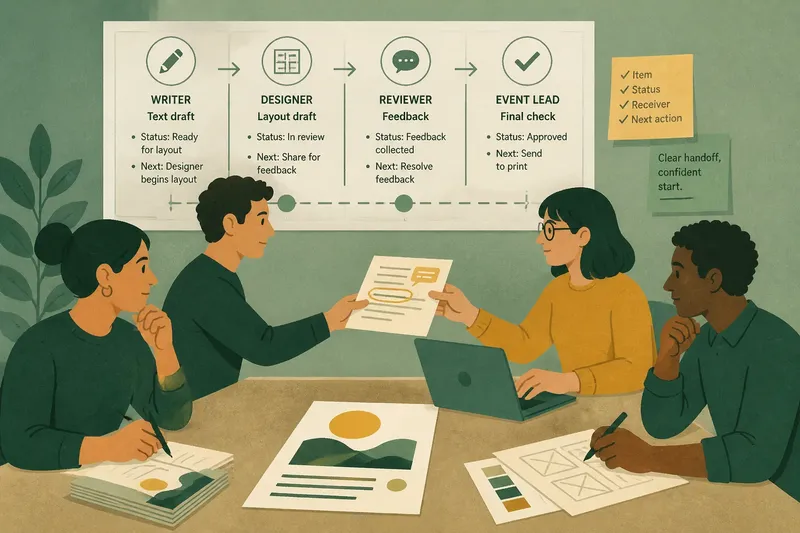
A first team project handoff works when the next person can open the right material and take a clear first action. For every transfer, name what is being passed, its current state, who receives it, and what signals that work can begin.
This keeps a small creative project moving without adding layers of approval. If work stalls, inspect the transfer before assuming someone has lost motivation or skill.
Map the handoffs before assigning tasks
A task list says what people should do; a handoff map shows how their work connects. Choose a contained project, such as an event invitation, a small zine, or workshop materials. List the points where one person’s work becomes another person’s input.
For each transfer, record:
- Sender and receiver: who passes the work and who uses it next.
- Material: the file, draft, decision, or physical item being passed.
- Status: whether it is rough, ready for review, or approved for the next stage.
- Next action: what the receiver does first and what signal starts that work.
Say you are making a one-page invitation. The writer passes a text draft to the designer, with event details checked and open questions marked in comments. The designer can begin layout without guessing which wording is final. Revisions may still be needed, but the starting point is clear.
Keep the map in a shared document or project board. Trello, Notion, or a spreadsheet can all work; use labels that make status easy to see.
Make the input usable before the receiver begins
Problem: Someone says they are waiting, or starts by making assumptions that later need to be undone.
Likely cause: The handoff names a file but not its readiness. “Here’s the draft” could mean scattered notes or approved copy, and the receiver cannot tell settled decisions from placeholders.
Try this: Ask the receiver what they need to begin. Add those details to the handoff, mark uncertain material with comments or labels such as “placeholder” and “needs decision,” then agree on a start signal like moving the item to “Ready for layout.”
Do not make the receiver uncover hidden decisions. A short note can say: “Use the attached copy; the date is confirmed, the venue line is pending, and the image is a placement reference.”
Separate review comments from approval
Problem: A draft returns with broad comments, or several people request conflicting changes.
Likely cause: The team has not decided who gathers feedback, what kind of feedback is needed, or who resolves competing preferences. Review becomes an open-ended request to revise.
Try this: Name one person to gather comments. State the review question before sharing the work, such as “Are the event details complete?” or “Does the layout make the reading order clear?” Separate required corrections from optional suggestions and name who makes the final call for that stage.
Keep feedback beside the relevant material. Comments in a shared document are easier to act on than a separate message saying “tighten the copy.” If feedback changes a decision, update the handoff note so the next contributor does not use an outdated version.
Trace delays back to the blocked transfer
Problem: A deadline is close, but the team cannot identify what is holding up the next stage.
Likely cause: The plan tracks activity rather than readiness. The useful question is whether the next person has an input they can act on.
Try this: Start with the next unfinished output and trace backward. Find the last item accepted as ready, then name the missing decision, material, or response between it and the blocked work. Ask one person to resolve that gap and tell the receiver when the input will be available.
Do not send everyone into parallel work if their choices depend on an unsettled input. A designer can explore visual direction while copy is drafted, but final layout may need confirmed text. Mark exploratory work clearly so nobody mistakes it for a finished handoff.
Assign one owner to each deliverable
Problem: Two people edit the same material, or each assumes the other is handling a needed piece.
Likely cause: Broad roles leave the boundary between them vague. “Help with the invitation” does not say who owns the wording or who places it in the layout.
Try this: Assign one owner to each deliverable, even when several people contribute. Specify which decisions the owner can make and which need a check. For example: “Writer owns copy; designer owns layout; event lead confirms factual details.”
Ownership does not mean working alone. It tells the team who resolves a gap and prepares the next handoff.
Answer common first-project handoff questions
What belongs in a handoff note?
Name the item, its status, the receiver, unresolved questions, and the next action. Link to the current version so the receiver does not have to sort through old attachments.
How can a team tell whether work is ready?
Define readiness by what the receiver needs, not by a vague label like “done.” A text draft may be ready for layout when essential wording and factual details are settled, even if minor edits remain.
What if a contributor misses a handoff time?
Ask what is blocking the transfer and whether a usable portion can be passed now. Update the receiver with the new status and adjust dependent work rather than leaving the board to imply that nothing has changed.
Does every handoff need a meeting?
No. Use a written note for routine transfers, and meet when a decision is ambiguous or contributors need to resolve competing goals. Keep the meeting focused on the decision that unlocks the next action.
Improve one transfer after the project
After sharing the work, ask each contributor which handoff made their part easier and which left them guessing. Choose one confusing transfer to improve next time; changing every label and tool at once makes it harder to tell what helped.
A first team project handoff does not need elaborate coordination. Make the item, status, receiver, and next action visible, and the next contributor has a usable starting point instead of a puzzle to reconstruct.