From Apprentice to Peer Learning: Changing Ways to Pass on a Craft
Apprentice-to-peer learning helps craft knowledge travel through clear demonstrations, shared observation, and practical decisions about when learners can teach one another.
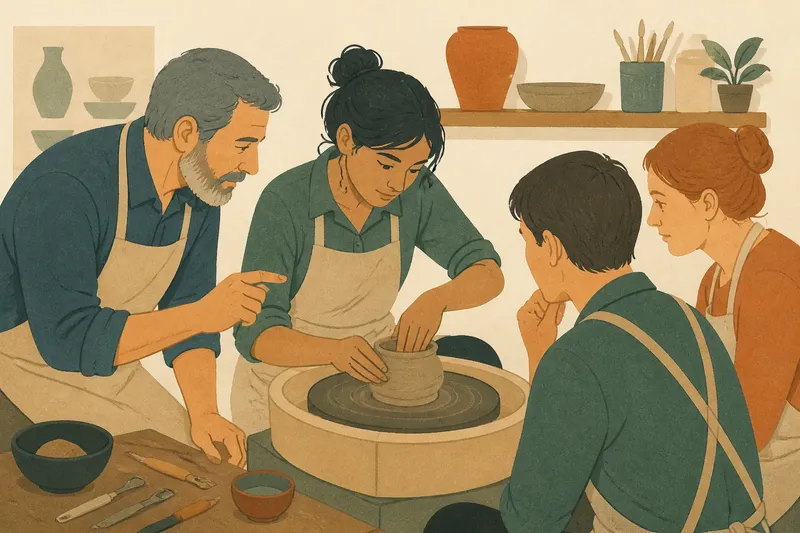
Apprentice-to-peer learning works best when a learner can explain a craft decision, not just repeat a motion. In a pottery studio, for example, an apprentice who can identify when clay begins to wobble may be ready to demonstrate that cue to another learner, with an experienced potter close by.
The shift is not a choice between an expert and a group. Apprenticeship gives a learner a clear reference and close correction. Peer exchange lets practitioners compare methods and make tacit judgments easier to discuss. Choose the format according to what learners can already recognize and what they still need help judging.
Apprenticeship makes hidden judgment visible
A close apprenticeship lets an experienced maker attend to a learner’s choices as they happen. The teacher can slow a motion, point out a change in material, and explain why a familiar technique needs adjustment. This matters when a task has linked choices and a beginner cannot yet tell which detail is important.
Pair demonstration with narration. A woodworker might show how a plane moves across a board, then name the grain cue that changes the angle or pressure. Watching without that explanation can leave a learner copying the movement without understanding the judgment behind it.
Use direct guidance when poor technique could cause harm, when a material is unfamiliar, or when a sequence is difficult to undo. It also helps learners establish a reference before comparing different approaches. The limitation is that knowledge can remain tied to one person’s habits. A learner may reproduce a demonstration yet struggle to adapt when the material or task changes.
Make the teacher’s decisions part of the demonstration.
Peer exchange reveals different workable methods
Peer learning lets practitioners compare how they approach a shared task. One person might explain how they judge a seam; another might demonstrate a different hand position or tool angle. The group can see that a craft may allow more than one sound method and discuss the conditions each method suits.
This is useful for tacit knowledge: the cues people notice before they can fully explain them. A weaver may hear a shuttle strike differently when tension is off. A printmaker may notice a squeegee dragging before a novice sees uneven ink. Pause at the cue, repeat the motion, and ask the maker what changed their next move.
Set a clear turn-taking pattern so one confident maker does not dominate. Ask each person to demonstrate one decision, invite a question, and let another participant try the same move in their own way. Compare choices rather than turning technique into a contest.
Rotating demonstrations connect guidance with shared authority
A rotating demonstration starts with an experienced practitioner establishing a baseline, then gives learners turns to show a variation or explain a correction. It keeps a reliable reference in view while making room for useful adaptations. This format suits groups that can exchange knowledge but still need help separating a purposeful variation from an avoidable error.
Keep each demonstration focused on one choice: preparing a brush, shaping a joint, or judging a fold. Ask observers to watch for a specific cue, such as the sound of a tool meeting material or the point when resistance changes. Then have the demonstrator explain the decision and invite someone else to try the move.
Say a small group is learning to mend canvas. The instructor demonstrates a baseline stitch and points out how thread tension affects the fabric. An experienced apprentice then shows how they handle a curved tear, while a peer notices when the needle starts pulling the edge out of line. The group’s observable result is that learners can name the tension cue and explain when the curved-tear adjustment applies, rather than merely imitating hand movements.
Respond to mistakes with observations before advice. “The edge gathered as the thread tightened” gives the demonstrator something specific to inspect; “You did it wrong” does not.
Choose a learning format by the judgment still missing
Start with what learners cannot yet recognize. If they cannot identify a sound or safe result, provide direct guidance. If they can do the task but cannot explain why an adjustment works, use peer exchange to bring their reasoning into view. If they need a reliable baseline and room to compare adaptations, rotate demonstrations.
- Check whether the learner can recognize a sound result. If not, use close apprenticeship and demonstrate the relevant cue; if yes, let the learner compare methods with a peer.
- Check whether the task has dependent stages. If a missed cue could undermine later work, keep an experienced practitioner close; if the stages can be inspected independently, let peers discuss one stage at a time.
- Check whether participants share enough vocabulary to discuss choices. If they do, use peer exchange; if they do not, establish terms and a baseline through direct instruction first.
- Check whether the group has useful experience as well as an expert reference. If both are present, rotate demonstrations; if learners cannot yet assess variations, return to the expert’s method.
- Check whether a demonstrator can explain the cue behind a movement. If they can, invite them to teach that bounded task; if they cannot, ask an experienced practitioner to narrate the decision before passing the demonstration on.
- Check whether observers describe what they saw before recommending a fix. If they do, compare the observations and discuss a response; if they jump to judgment, ask them to describe the material, movement, and visible result first.
After a session, ask each learner to name one cue they will watch for and one condition that could change their response. Their answers help you decide whether to continue peer exchange or return to closer guidance.
How should a group move from apprenticeship to peer learning?
When should an apprentice begin teaching a peer?
Start when the apprentice can perform a bounded task reliably and describe the choices involved, not only reproduce motions. Let them demonstrate that part while an experienced practitioner remains available to clarify important cues.
How can a group share tacit craft knowledge?
Ask the maker to pause when they change pressure, angle, pace, or attention. Invite observers to name what they saw or heard, then ask the maker what prompted the adjustment.
What should a group do when peers disagree about technique?
Ask each person to state which material or condition their method suits, then compare the visible results under that condition. If the group cannot judge the difference, ask a qualified craft instructor to clarify the relevant standard or constraint.
Does peer learning replace apprenticeship?
No. Peer learning broadens who can contribute, while apprenticeship offers close guidance when learners cannot yet assess a method. A craft group can move between the two as skills and responsibilities develop.
Keep shared learning accountable to craft standards
Passing on a craft does not require every learner to copy one person indefinitely. It requires a shared way to make decisions visible, inspect results, and preserve distinctions that matter. Apprenticeship can establish a baseline; peer exchange can reveal options; rotating demonstrations can connect them.
Use apprentice-to-peer learning when learners can explain what they notice, not merely repeat what they were shown. Keep a trusted instructor involved wherever the group cannot judge the work for itself. That boundary lets knowledge travel between practitioners while giving each learner room to develop a considered hand.